
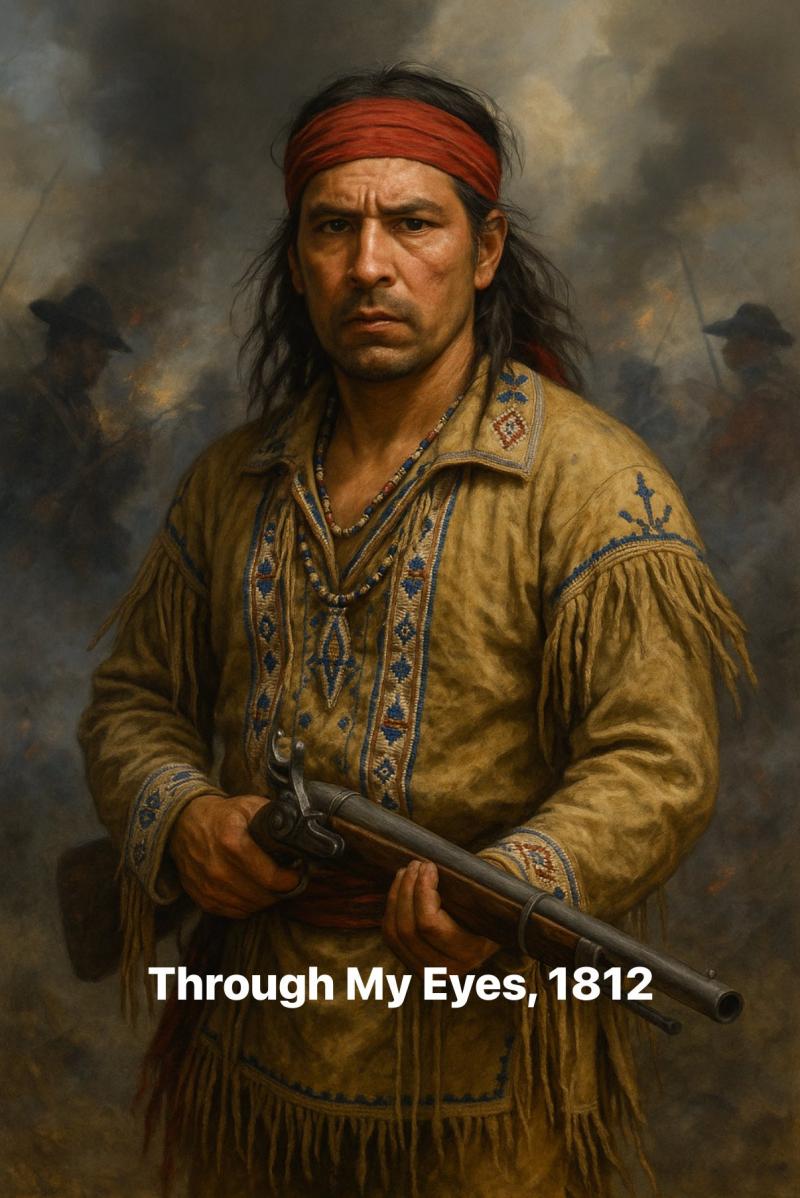
I’ve been reflecting on the War of 1812. We’re usually taught it through the eyes of Britain or America &mdash generals, flags, and politics. Rarely do we hear it through the eyes of those caught in between.
As an Acadian Mi’kmaq, I often wonder: what if I, Donald Joseph Cormier, had stood on those battlefields? Carrying the scars of exile and loss, fighting in a war that was never truly mine?
So I wrote it &mdash a short story, part history and part imagination, told through my own lens of trauma, resilience, and survival. It’s not in the textbooks, but maybe it lets you see 1812 in a new light: not just as armies clashing, but as the lived experience of people like us, caught in the storm.
A Short Story: Through My Eyes, 1812
I am Donald Joseph Cormier, son of the Acadian people, blood of the Mi’kmaq, and a survivor of too many losses. By the time the year 1812 came, I had already lived through more than any man should. I carried the weight of Grand Dérangement &mdash the exile of my Acadian kin &mdash and the scars of betrayal by crowns and churches alike. My Mi’kmaq blood kept me tied to the land, but the land itself had become battlefield after battlefield.
They didn’t have a name for what I carried then. Today they’d call it PTSD &mdash back then, it was just a broken spirit, a man whose sleep was torn by screams and whose waking hours trembled with unseen dangers. My body lived, but my mind was forever at war.
When America declared war on Britain, they weren’t just aiming at the king &mdash they were aiming at the land I stood on, the rivers my people fished, the forests where the Mi’kmaq still hunted. They called it the War of 1812, but to me it was another chapter in a long story: the strong trying to devour the weak.
I was not a soldier by uniform, nor was I trusted to hold rank. Acadians had been made to kneel before British muskets a generation earlier, and Mi’kmaq were seen as useful allies when it suited the crown, disposable when it did not. If I fought, it was as a militiaman when they needed numbers, or as a guide when they needed paths through swamp and forest. Never fully trusted, never fully free.
Still, I fought. Not for the Union Jack, and certainly not for Washington’s republic. I fought because this was my land, because my ancestors’ bones were in its soil, because I could not bear to see it swallowed by strangers’ greed again.
I remember Queenston Heights most vividly. Smoke rolled across the Niagara escarpment, and the thundering roar of cannon made the ground quake. The British regulars held their lines in red, the Canadians &mdash farmers and blacksmiths &mdash clutched muskets with shaking hands, and the Haudenosaunee warriors moved like shadows among the trees. I stood with them, musket in hand, every muscle tight as though I were a hunted deer.
When the Americans came charging, their numbers were overwhelming &mdash eighteen to one, sixteen to one, the odds never in our favor. My stomach twisted with terror, my mind screaming that this was another expulsion, another slaughter. But then Tecumseh’s men struck like thunder, and the American line broke in confusion. I fired, I reloaded, I fired again &mdash my hands working on instinct while my mind reeled with panic. I could hardly breathe, but I kept fighting.
At night, by the fires, men sang victory songs. I sat apart, staring into the flames, haunted by faces I had already lost &mdash Acadian cousins cast out by the British, Mi’kmaq kin starved by colonial greed. My body shook though no one struck me. My brothers in arms called it cowardice, but I knew it as the sickness of memory &mdash invisible, yet as deadly as any musket ball.
I was no slave in chains, but I was no free man either. In truth, all of us Acadians, all of us Mi’kmaq, lived in bondage of another kind &mdash to empires that used us when useful and abandoned us when spent. Slavery of the Acadian people was not written in law the way it was for Africans stolen to this land, but it was lived in spirit: our homes burned, our families scattered, our dignity bartered away. Still, we endured.
The Americans never conquered Canada. They came with overwhelming numbers, yet they broke upon us like waves against rock. And though history would give the glory to generals in red coats, I know the truth: it was the Indigenous warriors, the Acadian farmers, the Mi’kmaq hunters, the frightened militia &mdash those whose names will never be written in gold &mdash who kept this land unconquered.
As for me, Donald Joseph Cormier, I carried on. Haunted, wounded, half-forgotten, yet unbroken. For every empire that tried to erase me, still I stood &mdash Acadian, Mi’kmaq, and survivor of wars both seen and unseen.